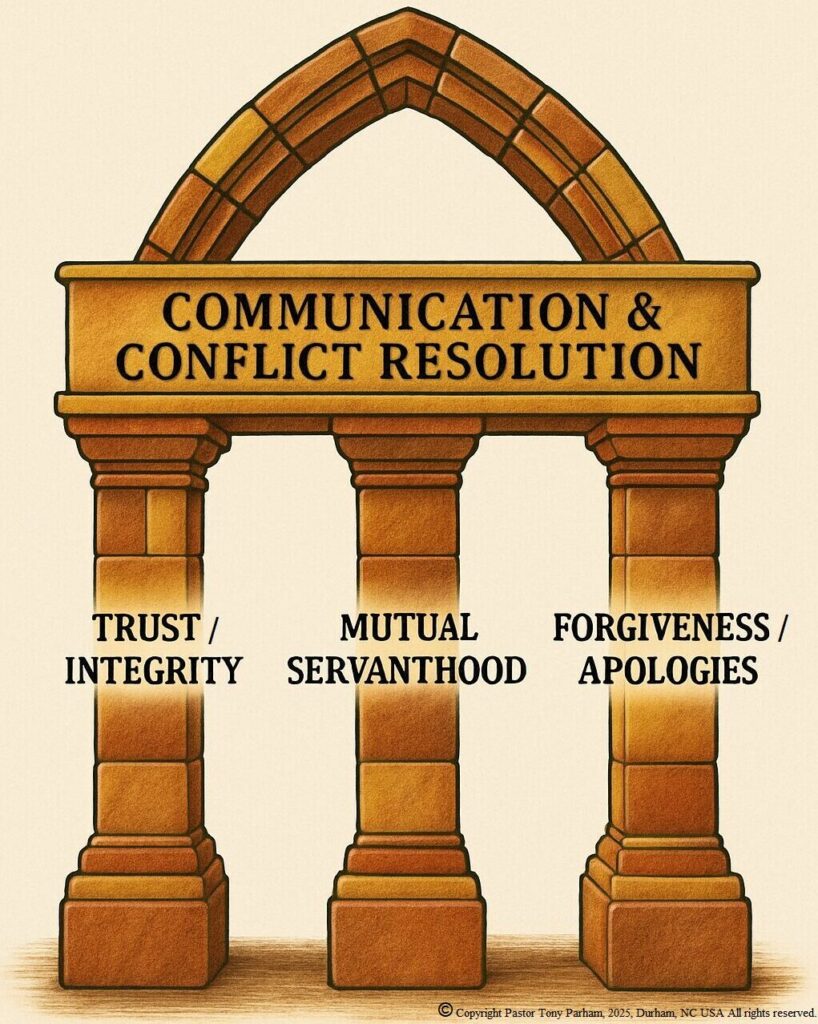
Communication & conflict resolution skills serve as the glue which holds everything together across the healthy relationship pillars. The most important communication and conflict resolution skills for a healthy marriage include active listening, empathy, direct and respectful communication, and problem-solving together.
Here are a few books which will help you to become more proficient in these areas:
- The Seven Principles for Making Marriage, by John Gottman
- The Five Love Languages, by Dr. Gary Chapman
- His Needs Her Needs, by Willard F. Harley, Jr
- Fight Right, by Julie Schwartz Gottman, Ph. D and John Gottman, Ph. D
- Unoffendable, by Brant Hansen. (Giving up your “right” to be offended will improve your relationship.)
- Us (Getting past “you and me” to build a more loving relationship), By Terrence Real
Excerpts from “Unoffendable”
- Anger offers us a sense of moral superiority.
- We want to think people are worse than us. It’s one of our favorite pastimes.
- Whatever anyone’s done to me, or to anyone else, I stand just as guilty.
- Life is full of conflicts, disputes, differing perspectives… and in all of those, guess whose perspective I hear first? That’s easy: mine.
- God knows others’ private motives. We don’t. God knows our private motives. We don’t. We think we can judge others’ motives. We’re wrong.
- Anger does not enhance judgment.
- Your life will become less stressful when you give up your right to anger and offense. And by the way, if you don’t, you’re doomed. So there’s that too.
- The thing that you think makes your anger ‘righteous’ is the very thing you are called to forgive. Grace isn’t for the deserving. Forgiving means surrendering your claim to resentment and letting go of anger. Anger is extraordinarily easy. It’s our default setting. Love is very difficult. Love is a miracle.
- A big part of being less offendable is seeing the human heart for what it is: Untrustworthy. Unfaithful. Prone to selfishness. Got it. Now we don’t have to be shocked.
- We can recognize injustice, grieve it, and act against it—but without rage, without malice, and without anger.
- That’s the thing about gratitude and anger: they can’t coexist. It’s one or the other. One drains the very life from you. The other fills your life with wonder. Choose wisely.
- Seek justice; love mercy. You don’t have to be angry to do that.
– Brant Hansen
Excerpts from “Us”
—Terence Real
- You and your partner are not, in fact, going to see all things the same way.
- “Us” is the seat of closeness. ‘”You and me” is the seat of adversarial contest. “You and me” is great when you are confronting a tiger, but less so when you are confronting your spouse, your boss, or your child.
- You can choose…to pollute your biosphere with a fit of temper over here. But you’ll breathe in your partner’s withdrawal or resentment over there. You and they are a linked ecosystem. There is no escape.
- You can choose…to pollute your biosphere with a fit of temper over here. But you’ll breathe in your partner’s withdrawal or resentment over there. You and they are a linked ecosystem. There is no escape.
- There is no redeeming value whatsoever in harshness. Harshness does nothing that loving firmness doesn’t do better.
- Once one learns to think relationally and ecologically, the answer to the question “Who’s right and who’s wrong?” becomes “Who cares?” The real question is “How are you and I going to navigate the issue at hand in a way that works for both of us?”
- Before you open your mouth, I want you to stop and think. Ask yourself: “What is the thing I’m about to say going to feel like to the person I’m speaking to?”
- What might have been a fight that lasted forty years is resolved in moments because it was lifted out of our usual frame of right/wrong, win/lose into the new world of relational thinking.
- Remember that Love is the seat of closeness.
- In close relationships, urgency is your enemy, and breath is your friend. Breath can change your heart rate and your thinking physiologically.
- Relational Heroism: That moment when every muscle and nerve in your body is screaming to do ‘the same old’ — but through raised consciousness, insight, discipline, and grace, you lift yourself off your accustomed track and deliberately place yourself on another track. You shift from the automatic, thoughtless response, from your ‘you and me’ consciousness, your Adaptive Child, to something new, something more relational, more connected, more mature. You call on your non-triggered ‘us’ consciousness, your Wise Adult.
Dealing with difficulties
If you’re having difficulty in your relationship, a good start would be to offer – TODAY! – sincere, unconditional apologies for things in the past.
Is also important to get help! Everyone needs help from time to time. Having a therapist, counselor, pastor and/or spiritually-mature couple/friend work with you can provide objective assistance and wisdom which can help you navigate tough places.
In addition, the beginning of a good road back to help in this might start with a commitment to do the following:
Every morning, tell your spouse:
- I love you, I am committed to you, I will do my best to meet your needs.
- Please forgive any shortcomings I might display today as I pursue these goals.
Every night, tell your spouse:
- I love you, I am committed to you.
- I am sorry I [did X, or said X] today. Please forgive me. I will try to do better tomorrow.
Dealing with Gridlock
Please read chapter 11 in Gottman’s book, “The Seven Principles for Making Marriage Work.” The chapter is entitled, “Overcome Gridlock.”
Excerpt from “The Seven Principles for Making Marriage Work” — “Overcome Gridlock.”
“When couples gridlock over issues, the image that comes to my mind is of opposing fists. Neither can make any headway in getting the other to understand and respect their perspective, much less agree with it. As a result, they eventually view the partner as just plain selfish. Each becomes more deeply entrenched in his or her position, making compromise impossible. […]
Gridlock is a sign that you each have dreams for your life that the other isn’t aware of, hasn’t acknowledged, or doesn’t respect.”
—John Gottman